From AI Ambition to GGZ Impact
How do you, as a GGZ organization (mental healthcare), steer the development of AI? That question is central for a growing number of GGZ institutions that Ideal Shift AI guides. Instead of quickly doing “something with AI,” they consciously choose direction and strategy. Emma Verhagen, Managing Director of Ideal Shift AI, shares openly how she guides GGZ organizations in steering change, making bold decisions, and building a future-proof care organization.
Ideal Shift AI sees AI as a triple transformation: of work processes, of services, and of people. By changing these three levels in coherence, and by being sharp from the start on human contact, data, and governance, forward-thinking GGZ organizations and Ideal Shift AI jointly take the lead in a careful and future-proof application of AI. The core: innovative leadership makes you future-proof.
From Tool-Thinking to Value Creation
A recurring pattern among GGZ organizations that start with AI: the potential is great, but the financial room is limited. GGZ institutions work with narrow margins, so investing in AI calls for sharp choices and a combination of own resources and subsidies. On paper the returns are quickly visible, but in practice investing in innovation remains nerve-racking in a sector where every euro counts.
What stands out at the start of AI projects in the GGZ is that support within organizations turns out to be surprisingly broad. In Ideal Shift AI’s projects we see that at the start of a project, on average around fifteen percent of employees are actively involved in AI brainstorming. What begins as an intended core group grows into a broader movement. Deliberately, everyone who wants to contribute ideas is invited to join. Employees are literally “at the wheel,” and supervisory boards also look on positively. The effect is tangible: more ownership, more trust, and less resistance. Employees experience AI not as something that happens to them, but as something they themselves give direction to.
When the conversation turns to the risks of AI, it becomes clear that this requires a great deal of attention. From the start it is essential to pay explicit attention not only to privacy and data security, but also to themes such as bias (discrimination embedded in AI systems), loss of humanity, dependence on technology, and the question of responsibility. The conclusion is clear: AI must never become a standalone IT project, but must be carried organization-wide, with clear ethical frameworks and targeted training for employees.
Governance, too, is steered deliberately. The applications are not central; first comes the question of whether the organization is technically and organizationally ready for this. AI should land in an integrated way within the existing (Microsoft/Azure) landscape. For this, Ideal Shift AI applies its own AI Strategy Framework: a structured approach based on MIT insights, which guides the organization step by step from strategy definition and readiness assessment to a concrete AI roadmap aimed at value creation. From the multitude of ideas, sharp choices are then made, reduced to a limited number of coherent themes for the organization, work processes, and care content.
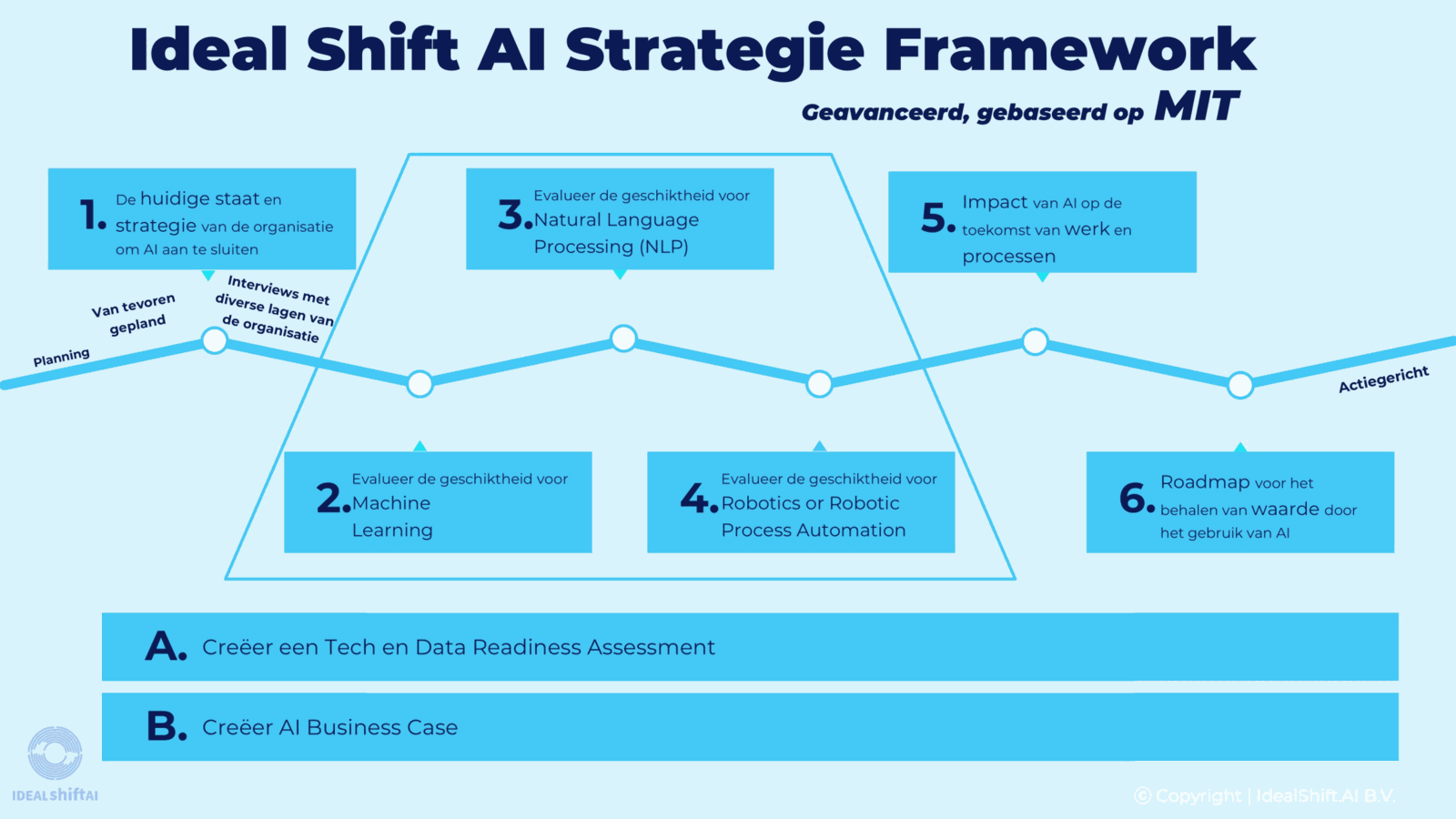
The business case remains the common thread throughout. AI is not deployed because it can be, but because it demonstrably contributes to goals the organization already considers important. A cost-benefit analysis (KPIs) is both the starting point and the anchor point. With a structured approach, it turns out to be possible to arrive at a supported AI strategy within one to two months, provided there is always a return to the core question: does this fit who we are as an organization?
A clear boundary is explicitly guarded here. AI may support care, but must never automatically lead to higher workload or more clients per day. Human contact remains leading, and the well-being of employees weighs at least as heavily as efficiency. In a sector where pressure and absenteeism are already high, that is not a nuance, but a hard precondition.
From Vision to Practice
The expected result of a well-designed AI trajectory in the GGZ: deploying technology to shorten waiting times and reduce workload, without crowding out the conversation between client and practitioner. The key is that such a trajectory does not begin with a tool, but with the question of where AI actually adds value for clients and employees alike. Administrators fulfill a facilitating and framework-setting role in this, with the public interest always as the starting point.
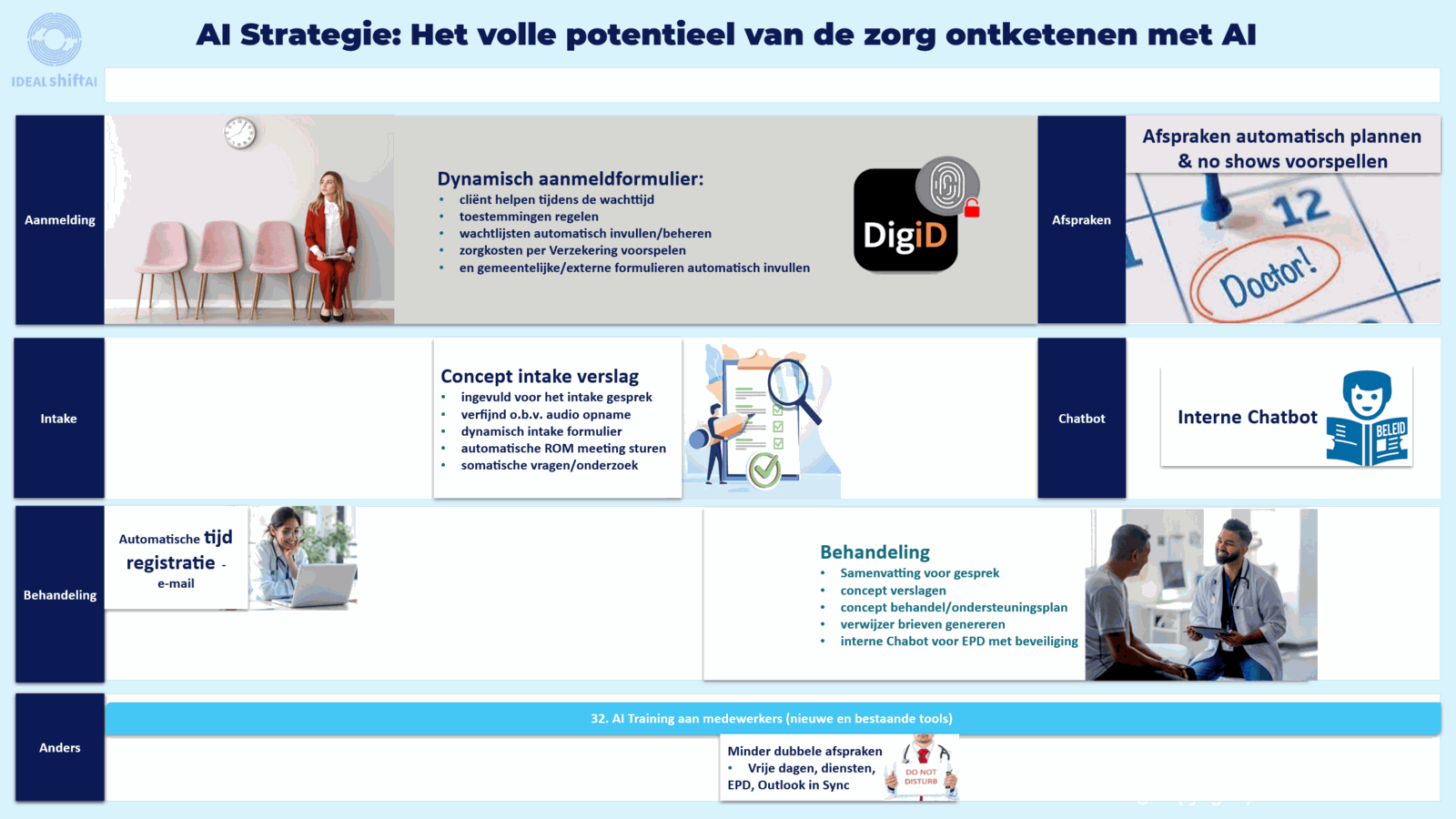
The AI strategy that Ideal Shift AI develops for GGZ clients is not set up as a collection of separate applications, but as an end-to-end redesign of the care process. During conversations with employees, it consistently emerges that data is only one part of a larger whole. Ideal Shift AI designs data, workflow, and human input in coherence, so that grip is gained on processes and future AI applications can land safely and at scale.
That approach is worked out along five successive phases that follow the logic of daily practice:
Phase 1: Registration ✓ Live in the GGZ
It begins with registration, where the AI foundation is laid. Registration forms are almost fully automated and collect information in a structured way. Consents are processed automatically, and waiting lists fill themselves based on current data.
Phase 2: Email Registration ✓ Almost Live
A concrete example is automatic email registration. Currently, registering a sent email costs a practitioner around 30 clicks, which amounts to 5 minutes per email or a missed registration with financial risk as a result. After implementation, a pop-up appears automatically after sending, with all relevant fields such as client, module, and duration already pre-filled. With 1 to 3 clicks the registration is complete, so that the expectation is that 90% of emails will be processed automatically.
Phase 3: Hybrid Digital Care with AI ✓ In Development
Research shows that clients often deteriorate during the waiting period. To counter this, AI uses a targeted questionnaire to map out on which GGZ themes a client needs the most support, and automatically recommends the most relevant trainings via platforms such as Minddistrict or Therapieland. This way the client is already actively working on recovery before treatment starts. At intake, AI continues this: based on the client profile, the most fitting specialized modules are recommended directly, with which the practitioner can easily deploy hybrid care.
Phase 4: Intake
In the intake phase, all previously collected information comes together. Dynamic intake forms and, where desired, a recording of the conversation automatically lead to a draft intake report. The practitioner only needs to check and refine this report, which creates more room for the substantive conversation.
Phase 5: Treatment
During the treatment period, AI supports conversation summaries, draft reports, and treatment support plans. An internal, well-secured chatbot helps employees with questions about processes and records; deliberately without an external chatbot facing clients. From ethical and safety considerations, the direct contact between client and practitioner remains leading.
Phase 6: Completion
In the closing phase, the emphasis is on calm and continuity. Through better planning and fewer double appointments, more overview arises in schedules and workload. Employees are supported with targeted training in the responsible use of AI, so that technology contributes to sustainable work and is not experienced as an extra burden.
Together, these phases form one coherent whole, in which AI is not deployed in a fragmented way, but contributes structurally to better care processes with attention to both clients and employees.
Parallel to this substantive development, measurement is prioritized from day one. Without a measurement culture, AI becomes either a toy or a source of distrust. That is why KPIs and business cases are explicitly part of the approach. Among other things, attention is paid to waiting times, treatment duration, billable time, and workload in administrative processes.
What Does This Deliver for Employees and Clients?
The choices that GGZ organizations make together with Ideal Shift AI are deliberately process-based and built up in phases. That makes it possible to also make the first effects visible, through which further support arises. Not only in figures, but precisely in the daily practice of employees and clients.
For practitioners, the greatest gain lies in calm and overview. Because a large part of the administrative actions is handled automatically, a structural source of workload disappears. Fewer clicks in the electronic patient record (EPR) means less chance of errors, less rework, and above all: more time for substantive work. This way, emails can be processed into the client’s record via a pop-up with a single press of a button.
More predictability in the work also arises. Registrations are no longer postponed or forgotten, through which financial uncertainty decreases. Employees have to switch less between systems and can focus their attention better on the treatment process itself.
Important: effectiveness does not automatically lead to higher production pressure. The time freed up is explicitly seen as room for more personal care, peer consultation, reflection, and recovery moments. That is a conscious choice, prompted by the realization that sustainable care begins with the well-being of professionals.
For clients, the approach translates above all into clarity and continuity. The registration process is clearer, and information is in better order from the start. That prevents noise and uncertainty at the start of a trajectory, precisely at a moment when clients are often vulnerable.
Throughout the entire process, from registration to discharge, human contact remains leading. Because administrative burdens disappear into the background, more room arises for the conversation itself.
From Results to Opportunities for the Sector
The experiences in GGZ practice show that AI adoption is not only a technology question, but above all a task of organizational change and process improvement. The change lies emphatically on three levels: the people (administrators who give direction, professionals who work with it, and clients who experience it), the technology (from data and applications to infrastructure and security), and the process (from registration to treatment and completion). Precisely that coherence determines whether AI actually adds value.
That is where the added value lies: not in delivering separate AI tools, but in guiding the full transformation, from vision and strategy to process design and implementation, fully integrated into your EPR and landscape. With targeted change management, AI adoption becomes a coherent change trajectory in which board, professionals, and clients learn together, adjust course, and develop ownership. Not a one-off project, but lasting change.
Successful application calls for clear administrative direction, careful redesign of care processes, and a well-considered change and adoption approach in which employees and clients are taken along. In addition, it is essential to steer not only on financial returns, but also on workload, quality of care, and client experience.
Practice in the GGZ underlines that organizations above all need support in the translation from vision to execution: making sharp choices, working in phases, and continuously adjusting course on the coherence of people, technology, and process. AI is not a goal in itself here, but a means to strengthen the primary process. Those who adopt that starting point increase the chance of lasting impact in care.
Key Outcomes
- End-to-end redesign of the care process, from registration to completion
- Strongly reduced administrative burden through automation
- Faster and more consistent screening and intake
- Broad support and ownership among employees
- Human contact and professional well-being as a hard precondition
- A measurable approach with KPIs and business cases as anchor point
Want to Know More?
The openness about dilemmas, workload, and ethical considerations invites reflection, not only within individual organizations, but across the entire sector. The core question remains: how do we build together toward a future-proof GGZ in which technology supports people?
Do you want to talk further about shaping an AI vision and strategy based on your multi-year strategy in your GGZ organization? Or do you want to build or automate something specific with AI? Get in touch with us. Together we build the GGZ care of tomorrow.