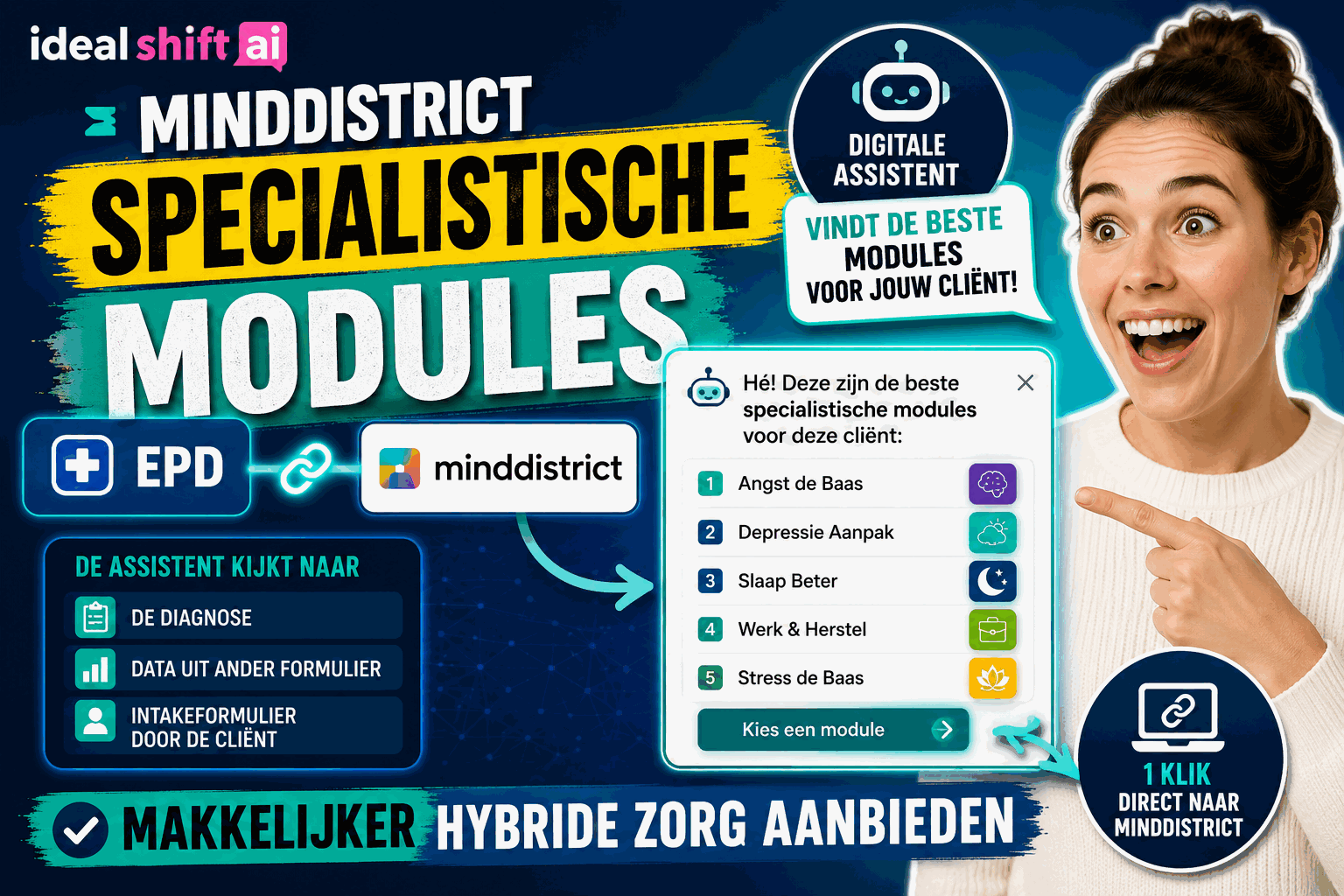
A smart AI integration between the EHR and Minddistrict
How can a mental healthcare organisation help clinicians find exactly the right training for a client among hundreds of available e-health modules, without adding administrative pressure? Ideal Shift AI developed an intelligent digital assistant that connects the EHR with e-health platforms such as Minddistrict.
By combining available client information with the characteristics of the full e-health catalogue, the clinician receives evidence-informed, personalised recommendations. They appear not in a separate system, but precisely when the care plan is being created or updated.
From information overload to personalised care
E-health platforms offer an ever-growing range of specialised modules. This is valuable, but makes it practically impossible for clinicians to know every module, target group and potential application. Manual searching takes time and can mean that suitable digital support is used late or not at all.
The digital assistant takes over the demanding search and comparison work. The clinician remains in control and receives a concise, relevant selection instead of an entire catalogue.
How does the AI assistant work?
- Data analysis: the assistant uses relevant available EHR context, including diagnosis, intake forms and questionnaires.
- Metadata matching: this context is compared with the content, target groups and characteristics of the available Minddistrict modules.
- Smart selection: the match produces a personalised top five or top ten of the most relevant modules.
Seamlessly embedded in the workflow
The recommendations appear when the clinician opens the care plan in the EHR. Rather than adding another task, the support becomes part of the existing decision-making moment.
After selecting a recommended training, such as Understanding your ADHD or Reducing social anxiety, the connection to Minddistrict opens. The clinician can then assign the selected module to the client.
Professional control, privacy and responsible implementation
The AI recommends; the clinician reviews and decides. Professional responsibility therefore remains where it belongs. A secure, authorised integration, data minimisation and clear access and use policies are essential foundations for implementation with client data.